In July 2008, French cybercops arrested two video pirate groups: CaRNaGe that was specialized in the capture of content, and Cinefox that managed a distribution site. Four years later, the French justice took its decision. CaRNaGe members (2 people) have been sentenced to 3-6 months of conditional jail and 410,000€. Cinefox members (3 people) have been sentenced to 6 months of conditional jail and 710,000€.
Category Archives: Copyright
ReDigi.com the resale locker
I must confess that I became aware of this interesting initiative only this summer, although ReDigi operates since October 2011.
ReDigi is a site that allows you either to resell your music songs that you do not want anymore, or purchase music songs that people do not want anymore. In other words, a second-hand market for music.
How does it work, from the user point of view:
- Alice user subscribes to the service
- ReDigi locates the songs Alice may resell (either purchase with iTunes, or ReDigi)
- Alice selects the songs to sell and reDigi stores them in the cloud while wiping out the copies on the computers
- As long as the song is not yet sold, Alice can stream it
- Once Bob purchased it, she cannot anymore listen to it.
- If ever a copy of the sold song appears again on Alice’s device(s), she is notified.
How does it work (partly using the details provided by ReDigi in a court trial, an interview, and my guesses)
- She has to install a software called Music Manager
- Music Manager explores the directories and spots the iTunes and ReDigi songs. It most probably directly jumps to the FairPlay protected directory to find the licenses. It checks if it is legal (in other words if it can access the key, then meaning that it was bound to the device)
- It uploads the file (and probably the license) to the cloud and erases the accessible song. At next sync, all iTunes copies should disappear.
- The uploaded copy is marked as such until it is sold
- Mark it for somebody else. I would like to know if they rebuild their own license or a new iTunes license.
- During phase 3, it extracts a fingerprint of the song. Music Manager scouts the hard drive to find copies. I was not able to find if the fingerprint is a basic crypto hash (md5) or a real audio fingerprint. If it is the second case, then funny things may happen.
Alice purchased Song1 on iTunes. Later she purchase the full album on a CD. Thus, she resells the iTunes song1, and rips her CD. A legit copy of Song1 will reappear on her drive. Music Manager will complain (ReDigi claims that after numerous complaints that would not be obeyed, i.e., the song is erased, the subscription is cancelled)
Obviously, if it is just the hash, then the system can be easily bypassed.
The interesting question is not if the system can be bypassed. I am sure that the readers of this blog have already guessed at least one or two ways to hack it. It is not complex, and I will not elaborate on it.
The interesting question is to know if it is legal to resell a digital song. There is a US first sale doctrine that allows to resell your own goods, nevertheless the answer may perhaps not be so trivial. See this article. We will soon have a (first) answer. On January 2012, Capitol Records filed a suit against ReDigi. On February 2012, the district court rejected the preliminary injunction. Oral arguments should start on October 5. This article gives a good summary of the legal case.
Google’s anti-piracy new step (2)
In January 2011, Google updated its auto completion feature to become more copyright friendly. In August 2012, Google made another movement in this direction. Ami Singhal, SVP Engineering, announced that the ranking algorithm will now take into account the number of valid copyright removal notices. Thus, in theory, sites with illegal content should appear lower in the pages.
Does it work? I used the same example than in related post: Black swan. The situation is better for auto completion. If you try with “Black swan pirate movie”, you do not find illegal content on the first pages. Nevertheless, if you try “Black Swan torrent”, the first page is only about illegal torrents; the first result points to the pirate bay!
By the way, when trying “Black Swan pirate movie” on Microsoft’s bing, the third proposed result points to streaming sites.
Google receives an astounding number of removal notices. According to Google’s transparency report, it received about 5,900,000 notices to remove URL for copyright infringement.
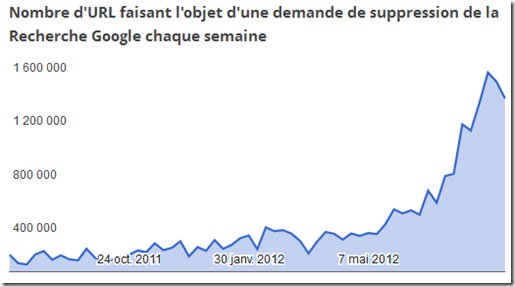
Source: http://www.google.com/transparencyreport/removals/copyright/ on 2012, September 3.
If they are all executed, it means that the execution is done automatically without a manual verifcation. There is no way to do it with systematic human supervision. May be Google uses a first step of screening with automatic fingerprinting recognition, and then manually examine the non detected ones. If somebody has a pointer that describes this process, I would love to read it. Or an educated guess?

Is French HADOPI law dead? (10)
In 2009, the French government launched HADOPI. The HADOPI is the institution responsible to handle the graduated response to copyright infringement via three escalating strikes. Three years later comes the time of the first bilan.
HADOPI sent out one million warning emails (first strike level) and 99,000 registered letters (second strike level) which resulted to 134 cases examined for prosecution. Today, no case reached the ultimate strike level, i.e. disconnection of the infringer from Internet. The reported cost is of 12M€.
In a recent interview to French newspaper “Le nouvel Observateur”, the French minister of culture, Aurélié FiLIPPETTI severely judged the results of HADOPI.
Ca coûte quand même 12 millions d’euros, 60 agents travaillent, pour un résultat qui me semble au final bien mince. Dans un contexte budgétaire serré, il faut avoir un souci d’efficacité, de réconciliation entre les artistes et les publics, et trouver des solutions qui soient réelles et qui permettent vraiment de financer la création et non plus se payer de mots.
A possible English translation is
This costs 12 million euro. 60 agents work for a result which seems to me light. In a tight budget context, it is mandatory to be efficient, to reconciliate the artists and the audience, and to find solutions which are real and that really fund creation and not to talk a lof of rubbish.
The minister claimed that she’d rather reduce the cost of solutions that do not have proven efficiency. Thus, what is the future of HADOPI?
The interview can be found here and here. Sorry, it is in French.
Copyright and 3D objects
In march, I reported that The Pirate Bay added a new category of torrents dedicated to physibles. Physibles are files that describe 3D objects for 3D printers. I was also betting that we would soon hear aboutthe first litigation about copyright and 3D objects.
It did not take long. Thomas Valenty designed two figurines inspired from the famous Warhammer game. He shared his physibles on thingverse, which is the reference site for physibles. End of May 2012, Games Workshop, the flag ship company for game figurines such as Warhammer or AD&D, sent a takedown notice to Thingverse using the DMCA. Thingverse removed the physibles.
We will soon more and more such cases. It will be simple when the gimmick is a good replicate of a copyrighted item. But what if it is slightly different? See the ongoing, world wide, copyright battle between Apple and Samsung regarding the shape of the Galaxy versus iPad…
Pending extradition for a UK alleged pirate
In December 2007, UK citizen Richard O’Dwyer established the TVShack site. TVShack did not contain any copyrighted files but actually linked to illegal contents stored on third party owned websites. As such, the site was not hosting illegal contents (as MegaUpload did). Nevertheless, it was a facilitator as it helped to locate illegal contents. This site soon became a success. The US authorities estimate that it made about $230,000 of advertisement. The site was among the first ones that were strike by Immigration and Customs Enforcement domain seizure strategy.
In May 2011, the US Justice Department asked for the extradition of Richard O’Dwyer under the two charges of conspiracy to commit copyright infringement and criminal infringement of copyright. The defense of O’Dwyer argued that the extradition was not valid because TVshack servers were not hosted in the US. On January 2012, an English judge ruled that O’Dwyer could be extradited to US. On March, UK home secretary Theresa May approved the extradition. Of course, soon an appeal against the extradition was presented.
In June, Jimmy Wales, the founder of Wikipedia, launched an online campaign to collect signatures to stop the extradition. The site has already collected more than 237,000 signatures. Recently, Theresa May confirmed that she will not reverse her decision, regardless of the potential success of the online petition. We will have to wait for the result of the appeal in the coming months.
As I am not a lawyer, I will not comment on the (il)legality of this extradition. Clearly, the US authorities try through such actions (like for Megaupload) to demonstrate that:
- No country is safe if you are infringing copyright on US industry
- Even facilitating copyright infringement can be prosecuted
“Securing Digital Video” is now available!
My book, “Securing Digital Video: Techniques for DRM and Content Protection” is now available on sale. It can be found directly at Springer (about one week delay), from US amazon (2-4 weeks delay) and from French Amazon (available only in August).
This is the last step of a long process. I hope that the reader will enjoy it and that it will be useful to the community. More details on the book are available here.
I would be glad to hear your suggestions, appreciations (even negative ones), and answer any question. For that, use preferably the address book@eric-diehl.com. I will always answer.